The Quartz Movement That Trades Gears for Crystal Time
A battery, a crystal and a stepper motor keep rate steady — different faults, different tools, still a real movement.
Specification
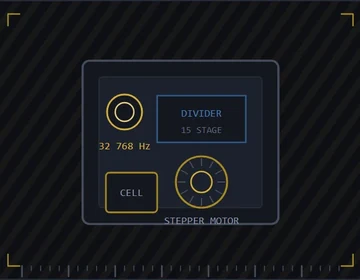
| Oscillator | Quartz crystal, 32,768 Hz |
|---|---|
| Jewels | 0 – 7 (bearing jewels only) |
| Steps per second | 1 (analog), 8 at 4 Hz variants |
| Typical accuracy | ±15 s per month, unadjusted |
| Cell life | 2 – 10 years |
| Diameter | 18 – 30 mm |
| Height | 1.8 – 5.2 mm |
| Timebase adjustment | Trimmer capacitor or digital inhibit |
Overview
Quartz movements keep time with a vibrating crystal oscillator and a circuit that drives a stepper motor. Mechanical instincts still help: train friction, hand interference and case magnetism can all stop a ‘perfectly fine’ module.
Battery work looks simple and fails loudly when done wrong. Leakage destroys circuits. The wrong cell height lifts the dial or leaves intermittent contact. Coil resistance and pulse checks tell you more than guessing.
Do not treat quartz as disposable by default. Many calibers are serviceable once you respect the electronics and the mechanical output wheel.
What matters about it
- Crystal frequency is the rate reference — not a balance wheel
- Battery chemistry and size are not interchangeable by eye
- Coil and circuit faults need measurement, not hope
- Hand clearance problems mimic dead batteries
- Stem and setting mechanisms still wear like mechanical parts
Practical notes
- Clean battery contacts; corrosion under a ‘new’ cell is common.
- Check hand stack height before condemning a motor.
- Measure coil resistance against the caliber’s published range.
- Insulate and seat the cell exactly as the bridge intends.
More in Movements & Calibers
The Self-Winding Movement That Keeps Itself Alive
A rotor turns everyday wrist motion into mainspring tension — and that is why a daily wearer rarely needs the crown.
The Tiny Wheel That Sets the Watch’s Pace
Mass, hairspring and timing screws decide the rate — get this oscillator wrong and every other adjustment is theatre.
The Escapement That Meters Every Tick
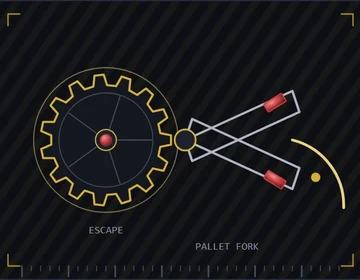
Escape wheel, pallet fork and impulse faces turn continuous torque into counted beats — this is where energy becomes time.
The Hand-Wound Movement Built for Deliberate Power
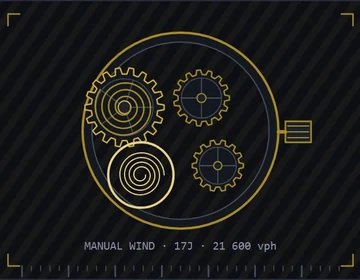
Crown, ratchet and click turn your fingers into stored torque — simple, transparent and honest about when it needs winding.