The Escapement That Meters Every Tick
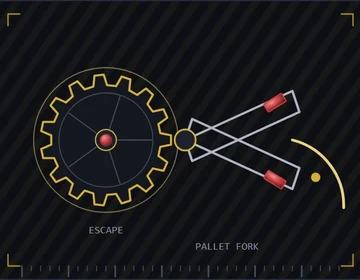
Escape wheel, pallet fork and impulse faces turn continuous torque into counted beats — this is where energy becomes time.
Specification
| Common types | Swiss lever · coaxial · detent |
|---|---|
| Jewels | 2 pallet jewels · 1 impulse jewel |
| Lift angle | 30° – 52° (set by geometry) |
| Lock | 1° – 2° of wheel rotation |
| Drop | Minimal free travel between tooth and pallet |
| Impulses per oscillation | 2 |
| Frequency support | 18,000 – 36,000 vph |
| Oil | Minimal, on the pallet faces only |
Overview
The escapement is the gate between the gear train and the balance. It locks, unlocks and impulsues in a rhythm that matches the oscillator. In a Swiss lever layout you will see an escape wheel, pallet fork with jewels, and a roller on the balance staff.
Depth and drop decide whether the watch runs free or binds. Too deep and you lose amplitude; too shallow and you get unreliable unlocking. Oil belongs only where the design asks for it — usually the impulse faces, never the locking corners if the manual says dry.
Listen and look: a healthy escapement sounds even. Uneven tick-tock often points to banking pin issues, a bent pivot or a roller jewel that is not seating cleanly.
What matters about it
- Locking and impulse are separate events — diagnose them separately
- Jewel condition changes friction more than most beginners expect
- Banking pins set the fork’s travel limits
- Lift angle links escapement geometry to timegrapher readings
- Dirt here looks like a weak mainspring elsewhere
Practical notes
- Clean pallet jewels carefully; residue on impulse faces kills amplitude.
- Check horn and guard-pin clearance before blaming the balance.
- Confirm escape wheel teeth are not burred after a crash.
- Reassemble with the fork free to move before fitting the balance.
More in Movements & Calibers
The Self-Winding Movement That Keeps Itself Alive
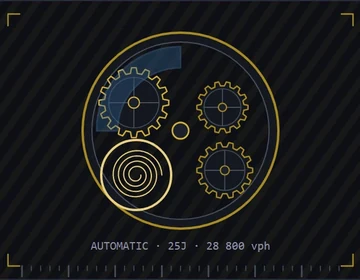
A rotor turns everyday wrist motion into mainspring tension — and that is why a daily wearer rarely needs the crown.
The Tiny Wheel That Sets the Watch’s Pace
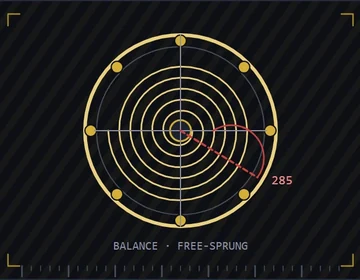
Mass, hairspring and timing screws decide the rate — get this oscillator wrong and every other adjustment is theatre.
The Hand-Wound Movement Built for Deliberate Power
Crown, ratchet and click turn your fingers into stored torque — simple, transparent and honest about when it needs winding.
The Mainspring Barrel That Holds the Watch’s Fuel
A coiled spring inside a toothed drum feeds the whole train — service this carefully or nothing downstream will behave.