The Tiny Wheel That Sets the Watch’s Pace
Mass, hairspring and timing screws decide the rate — get this oscillator wrong and every other adjustment is theatre.
Specification
| Typical diameter | 7 – 12 mm |
|---|---|
| Frequency range | 18,000 – 36,000 vph (2.5 – 5 Hz) |
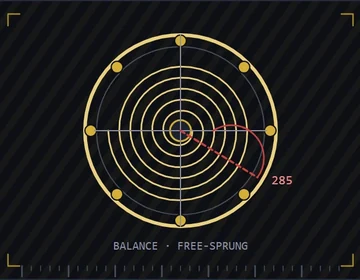
| Amplitude, flat | 270° – 310° (typical service target) |
| Beat error target | < 0.5 ms |
| Common materials | Glucydur · brass · beryllium bronze |
| Hairspring types | Flat · Breguet overcoil · silicon |
| Adjustment | Timing screws, timing weights, or index regulator |
| Jewels in the assembly | 2 – 4 (upper, lower, impulse) |
Overview
The balance wheel is the watch’s pendulum. Paired with a hairspring, it swings back and forth at a designed frequency while the escapement gives it a little push each cycle. Rate, amplitude and beat error all live here.
Timing is not a single screw. Poising, hairspring concentricity, stud and regulator position, and oil on the pivots all pull the rate. Change one variable without reading the others and you will chase numbers for an hour.
Under the loupe, look for bent pivots, magnetised hairsprings and hairspring coils that kiss. Those faults look subtle and time loud.
What matters about it
- Frequency is fixed by design — you trim, you do not reinvent it
- Hairspring geometry matters as much as the rim mass
- Amplitude tells you about power and friction, not just rate
- Beat error is a symmetry problem at the impulse
- Magnetism can ruin an otherwise perfect balance
Practical notes
- Demagnetise before you regulate if the hairspring looks sticky.
- Never stretch a hairspring to ‘fix’ rate — replace or reshape properly.
- Oil balance jewels sparingly; flooding kills amplitude.
- Record rate in several positions before touching the regulator.
More in Movements & Calibers
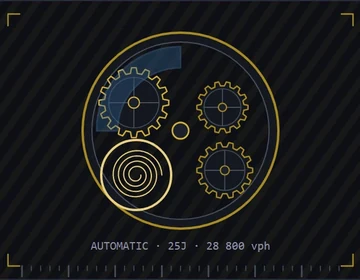
The Self-Winding Movement That Keeps Itself Alive
A rotor turns everyday wrist motion into mainspring tension — and that is why a daily wearer rarely needs the crown.
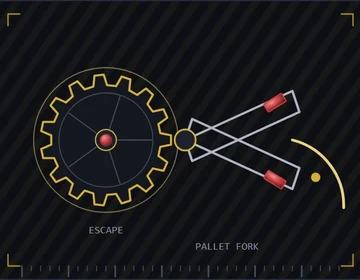
The Escapement That Meters Every Tick
Escape wheel, pallet fork and impulse faces turn continuous torque into counted beats — this is where energy becomes time.
The Hand-Wound Movement Built for Deliberate Power
Crown, ratchet and click turn your fingers into stored torque — simple, transparent and honest about when it needs winding.
The Mainspring Barrel That Holds the Watch’s Fuel
A coiled spring inside a toothed drum feeds the whole train — service this carefully or nothing downstream will behave.